
How Long Do Great Danes Live?
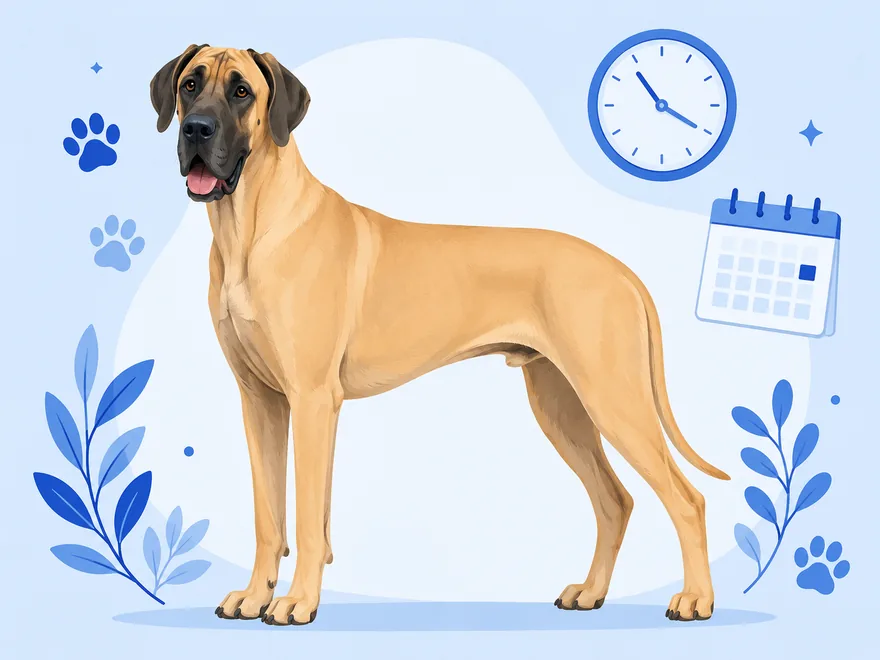
Great Danes live 7 to 10 years on average, the short end of the canine range, because they are a giant breed and size is the biggest predictor of a dog's lifespan. Bloat, heart disease, and bone cancer are the conditions most likely to cut that time short. Good weight, careful feeding, and routine vet care help.
How long do Great Danes live?
Great Danes live 7 to 10 years on average. As a giant breed (over 90 pounds), they sit at the short end of every canine lifespan chart. The American Kennel Club describes the typical span as 8 to 10 years, with some living only 6 or 7 and a lucky few reaching 12, which fits the 7 to 10 working range.
This is nearly a decade shorter than small breeds, which average 13 to 17 years. A Great Dane reaches each life stage one to three years sooner than a small dog, so a six-year-old Great Dane is biologically about where an eleven-year-old Yorkie is. You can see the full picture in our guide to dog lifespan by breed and size, or convert your dog's age with the dog age calculator on the giant setting.
Why do Great Danes have a short lifespan?
Great Danes live short lives mainly because they are giant. Across dogs, bigger bodies age faster, and the same growth signals that build a 140-pound frame appear to speed cellular aging.
- Size is the biggest predictor of lifespan in dogs. The breed's giant build, not bad luck, drives the 7 to 10 range.
- This reverses the usual rule that bigger animals live longer. Within dogs it runs the other way.
- The leading explanation is that the growth factors that drive large size also drive faster aging. The AKC puts it plainly: large dogs appear to live their adult lives in fast motion.
- Rapid puppy growth is itself a stressor, so controlled growth in puppyhood matters for giants.
What affects a Great Dane's lifespan?
Beyond giant size, the biggest levers are body weight, how the puppy is grown, diet quality, dental and parasite care, and routine veterinary monitoring, most of which the owner controls.
- Leanness. Keeping a dog lean adds roughly two years, and obesity can take years off an already short life.
- Controlled puppy growth. Giant-breed puppies need diets formulated to prevent excessive, too-fast growth, which protects joints and bones.
- Feeding pattern. Multiple smaller meals rather than one large meal, a bloat-risk consideration for deep-chested giants.
- Genetics and breeder. Responsible breeders test for hip dysplasia, heart disease, and thyroid conditions.
- Dental care, parasite prevention, and routine vet visits.
Common Great Dane health issues that shorten lifespan
Three conditions account for most early Great Dane deaths: bloat, dilated cardiomyopathy, and bone cancer. Joint disease and hypothyroidism are also common.
- Bloat (gastric dilatation-volvulus). The stomach fills with gas and can twist, cutting off blood supply. Deep-chested giants are the highest-risk group, and many owners discuss a preventive gastropexy at spay or neuter. Emergency signs include a swollen belly, unproductive retching, drooling, and restlessness.
- Dilated cardiomyopathy. A disease of the heart muscle that enlarges the heart. The breed is so prone to it that it is nicknamed the heartbreak breed. Signs include reduced stamina, coughing, fast breathing, and fainting.
- Osteosarcoma (bone cancer). Giant breeds are heavily over-represented. A UK study found Great Danes had about 34 times the odds of bone cancer compared with crossbreeds. The early sign is lameness or leg pain.
- Hip dysplasia and osteoarthritis, common in the giant frame.
- Hypothyroidism, often from autoimmune thyroiditis.
How to help a Great Dane live longer
You cannot change the breed's giant size, but you can manage every other lever: keep the dog lean, feed for slow growth and bloat safety, stay ahead of the big three conditions, and keep up routine veterinary care.
- Keep the dog lean, the highest-impact owner lever, worth about two years.
- Feed for bloat safety. Multiple smaller meals, and ask your vet about a preventive gastropexy for this high-risk breed.
- Grow puppies slowly on a giant-breed diet to protect joints and bones.
- Stay ahead of the heart. Ask your vet about screening for heart disease, especially around ages three to six when it commonly appears.
- Keep up routine care: vet visits, dental care, parasite prevention, and senior bloodwork once aging starts.
- Buy from a breeder who health-tests hips, heart, and thyroid.
When is a Great Dane considered senior?
A Great Dane is considered senior at 8 and geriatric at 10, earlier than any smaller dog, because giant breeds age fastest. As the site puts it, a Chihuahua hits senior at 10, a Labrador at 9, a Great Dane at 8.
- A graying muzzle, slowing down, and stiffness or arthritis. Most dogs over eight show some arthritis on an x-ray.
- Weight changes, cloudier eyes, and cognitive changes such as disorientation and disrupted sleep.
- A slower metabolism. Maintenance calorie needs drop 10 to 20 percent, so portions usually need trimming.
Senior bloodwork and twice-yearly visits help catch heart and other changes early. The senior check walks through the signs by age.
See your Great Dane's age in human years →Frequently asked questions
How long do Great Danes live?
On average 7 to 10 years. The AKC typically cites 8 to 10, with some living only 6 or 7 and a rare few reaching 12. As a giant breed, they sit at the short end of the canine lifespan range.
Why do Great Danes have such a short lifespan?
Because they are giant. Across dogs, larger bodies age faster, and the same growth factors that build their huge frame appear to speed cellular aging. Size is the biggest predictor of a dog's lifespan.
What do most Great Danes die from?
The conditions most likely to shorten a Great Dane's life are bloat, dilated cardiomyopathy (the breed is nicknamed the heartbreak breed), and osteosarcoma, a bone cancer to which Great Danes are about 34 times more prone than crossbreeds.
How can I help my Great Dane live longer?
Keep your dog lean, feed multiple smaller meals and ask your vet about a preventive gastropexy for bloat, grow puppies slowly on a giant-breed diet, screen for heart disease, and keep up routine vet, dental, and parasite care.
What is the oldest a Great Dane has lived?
Most Great Danes live 7 to 10 years, and a lucky few reach 12, which the AKC calls the ripe old age of 12. Reaching the early teens is uncommon for a giant breed.
At what age is a Great Dane considered a senior?
A Great Dane is a senior at 8 and geriatric at 10, earlier than smaller dogs, because giant breeds age fastest.
Is bloat really that common in Great Danes?
Yes. Deep-chested giant breeds like the Great Dane are the highest-risk group for bloat, which the AKC calls a dangerous and often fatal condition. It is the main reason many owners discuss a preventive gastropexy with their vet.
Sources
- American Kennel Club. Great Dane Life Span and Health Issues.
- O’Neill DG, et al. “Dog breeds and conformations predisposed to osteosarcoma in the UK: a VetCompass study.” Canine Medicine and Genetics, 2023.
- Teng KT, et al. “Life tables of annual life expectancy and mortality for companion dogs in the United Kingdom.” Scientific Reports, 2022.
Written by the Dogs Age Calculator editorial team · How we research & fact-check