
Puppy Development: Month-by-Month Through the First Year
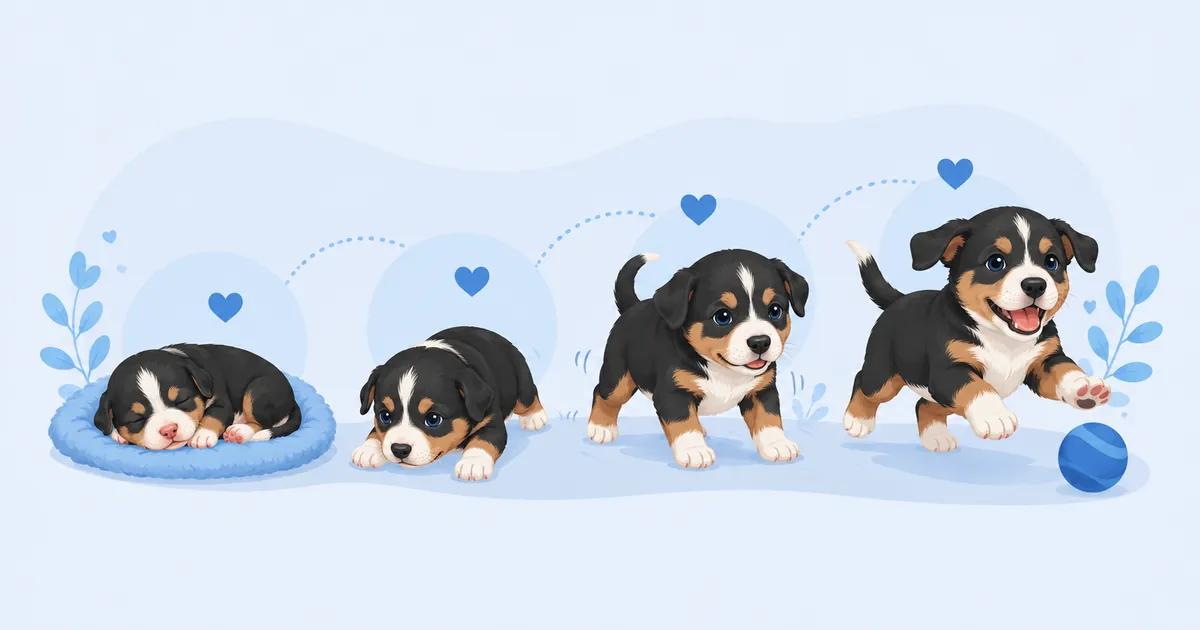
The first year of a puppy’s life is the most consequential year they’ll ever have. Nearly every aspect of adult dog behavior (confidence, sociability, fear responses, body-condition habits) is shaped during this twelve-month window. Knowing what’s normal at each stage makes it easier to spot problems early and to make the most of the developmental windows that close fast.
Months 0–1: Neonatal and transitional (0–4 weeks)
Newborn puppies are blind, deaf, and unable to thermoregulate. They sleep, nurse, and grow at a rapid pace, typically doubling their birth weight in the first week. Eyes open around day 14. Hearing develops by day 17–19. By the end of week 4, puppies are walking, retracting their claws, beginning to play, and producing solid stool.
If hand-raising orphaned puppies: warmth is critical, feedings every 2–3 hours with puppy milk replacer, and bottom-stimulation after each feed. Cow’s milk causes severe diarrhea and dehydration in puppies.
Months 1–2: Socialization window opens (4–8 weeks)
Weeks 3 through 16 are the most important socialization period of a dog’s life, and the first half happens before most puppies go home. Puppies in this window form their template for what’s normal and safe. Exposure to humans (handling, voices, faces), other puppies (bite inhibition through play), other species, ambient sounds, surfaces, and objects all shape adult confidence.
By 8 weeks, puppies are weaned, eating solid puppy food, mobile, and ready for their first vaccines and home placement. Responsible breeders and rescues don’t place puppies under 8 weeks; earlier placement reliably produces social and behavioral problems.
Months 2–3: First vaccines and home transition (8–12 weeks)
Most puppies go home at 8–10 weeks. First vet visit happens here. Standard recommendations:
- DHPP (distemper, hepatitis, parvovirus, parainfluenza) starting at 6–8 weeks, every 3–4 weeks until 16–20 weeks.
- Fecal exam and deworming (most puppies have parasites).
- Heartworm prevention starting.
- Microchip if not already done.
- Rabies vaccine at 12–16 weeks depending on local laws.
Continue active socialization. Until full vaccination, avoid dog parks and areas frequented by unknown dogs. Parvo is the major early-puppy risk, but carry your puppy in public, visit friends with vaccinated dogs, and continue exposing to new sights, sounds, and surfaces. The behavioral cost of skipping socialization to avoid disease risk is higher than the disease cost, in most environments. Talk to your vet about local risk balance.
Months 3–5: Critical socialization closes (12–20 weeks)
The socialization window starts closing around 12 weeks and is largely closed by 16. After this point, puppies become more cautious and less open to new experiences. Anything not encountered comfortably during the first 16 weeks will be harder to introduce later.
Specific exposures to check off during this window:
- Adults, children, men with beards, people with hats and glasses, people of varied ages and ethnicities.
- Other dogs (vaccinated, friendly, age-appropriate).
- Cars (riding in, walking near).
- Veterinary handling, brushing, nail-trim conditioning, ear-handling.
- Different surfaces: tile, grass, metal grates, sand, stairs.
- Noises: vacuum, doorbells, traffic, fireworks at low volume.
- Being alone for short periods (helps prevent separation anxiety).
The 16-week window
The strongest behavioral predictor of an adult dog’s confidence is the breadth of positive experiences in the first 16 weeks. Puppies often need 100+ different exposures during this window to grow into well-adjusted adults. Nothing else in your dog’s life pays back as much for the effort. Spend it well.
Months 4–6: Teething and rapid growth
Adult teeth replace baby teeth between 4 and 6 months. Expect significant chewing; this is a physiological need, not naughtiness. Provide appropriate chew toys (Kongs, nylon bones, frozen carrots). Avoid hard items that can crack adult teeth (antlers, raw bones from large animals).
Growth is fastest now. Small breeds will hit 70–80% of adult weight; large breeds will be growing for many more months. Continue puppy food appropriate to breed size.
Months 6–9: Adolescent onset (24–36 weeks)
This is the hardest behavioral phase for most owners. Trained behaviors suddenly “stop working.” Sit becomes negotiable. Coming when called becomes optional. Sudden fear of objects previously fine. This is normal adolescence and it ends. Usually around 18 months, sometimes later for large breeds.
Sexual maturity arrives in this phase: 6–9 months for small breeds, 9–15 months for large breeds. Spay/neuter timing has shifted. Modern guidance for large and giant breeds increasingly recommends waiting until growth plates close (12–18 months or later) for orthopedic and oncologic reasons. Talk to your vet about specific timing.
Months 9–12: Late adolescent (36–52 weeks)
Most small and medium breeds reach close to full size. Large breeds continue growing. Behavior starts settling slowly, though most dogs aren’t fully mature behaviorally until 18–24 months (or later for giant breeds).
Transition from puppy food to adult food timing depends on size:
- Small breeds: 9–12 months
- Medium breeds: 12–15 months
- Large breeds: 15–18 months
- Giant breeds: 18–24 months
Things to watch for at any puppy stage
- Failure to gain weight. Puppies should gain steadily.
- Persistent diarrhea or vomiting. Could indicate parasites, parvo, or dietary issues.
- Lethargy, lack of appetite. Puppies should be energetic when awake.
- Coughing, especially after kennel/daycare exposure. Could be kennel cough.
- Pale gums. Can signal anemia or parasite burden.
- Sudden lameness. Growth plates are vulnerable in large-breed puppies; avoid jumping and rough play before skeletal maturity.
Where they end up at 12 months
By the first birthday, most small and medium dogs are close to their adult size and weight (75–95%). Large breeds are mid-growth. Behaviorally, dogs are still in adolescence and won’t reach full adult maturity for another 6–12 months.
Use our dog age calculator to see exactly what your puppy’s age looks like in human-year terms. The number for year one is surprising, about 15 human years. Which is why one-year-old dogs feel so disproportionately developed for their calendar age.
The window that closes fast
The 3-to-16-week socialization window matters more than any other developmental factor for adult dog behavior. If you’re raising, fostering, or adopting a puppy, get them comfortable with everything they’ll need to navigate as adults in this window. Almost everything else can be adjusted later. That window can’t.
Calculate Your Dog’s Age & Life Stage →Sources
- American Veterinary Society of Animal Behavior. Position Statement on Puppy Socialization.
- American Animal Hospital Association. Canine Life Stage Guidelines, 2019.
- Hart BL, Hart LA. “Long-term health effects of neutering dogs.” PLoS ONE, multiple publications.
Written by the Dogs Age Calculator editorial team · How we research & fact-check