
When Is a Dog Fully Grown?
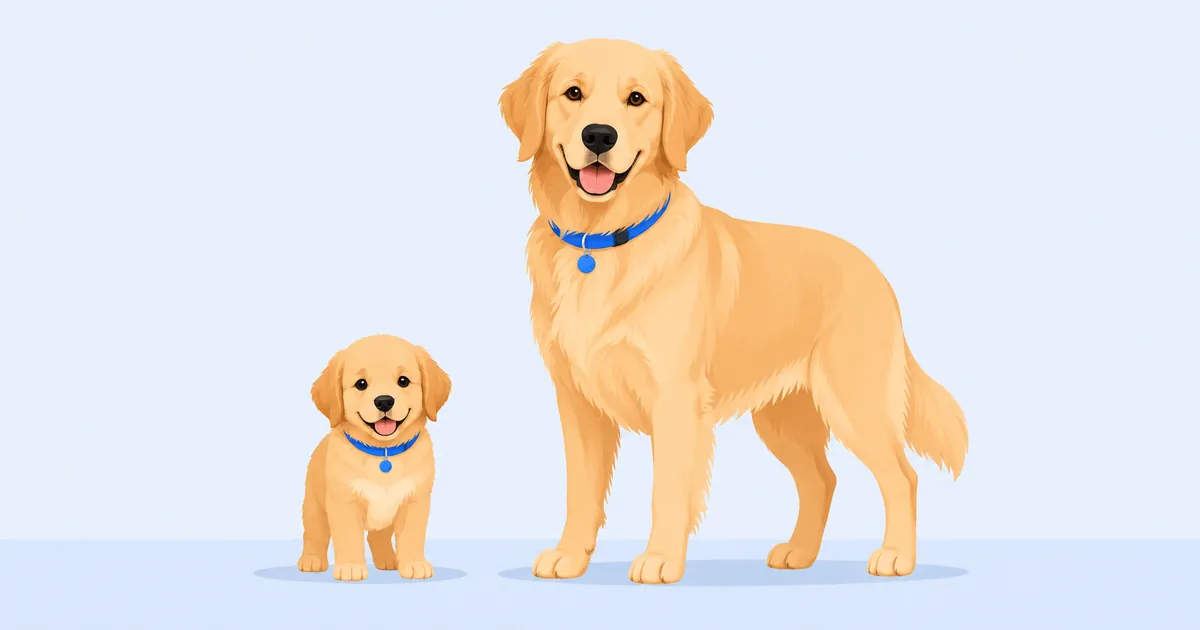
Dogs don’t finish growing on a single timeline. A Yorkie is done by 9 months. A Great Dane is still filling out at 24 months and can keep developing until 30. Knowing when your specific dog is finished growing matters for food transitions, exercise intensity, spay/neuter timing, and orthopedic safety. Here’s the breakdown by size.
What “fully grown” actually means
Three separate milestones get conflated:
- Sexual maturity typically arrives first: 6–9 months for small breeds, 9–15 months for larger.
- Skeletal maturity, when long-bone growth plates close. Happens later: 9–12 months for small dogs, up to 18–24 months for giant breeds.
- Adult body composition and muscle filling-out can continue another 6–12 months past skeletal maturity, particularly in working and giant breeds.
Growth timeline by size
Small breeds (under 20 lbs)
Skeletally mature by 8–12 months. Adult weight by 9–14 months.
Chihuahua, Yorkshire Terrier, Pomeranian, Toy Poodle, Miniature Schnauzer, Cavalier King Charles, Beagle. Fastest to finish. Switch to adult food around 9–12 months.
Medium breeds (20–50 lbs)
Skeletally mature by 12–15 months. Adult weight by 15–18 months.
Australian Shepherd, Border Collie, Bulldog, English Springer, Cocker Spaniel. Adult food transition around 12 months. Spay/neuter timing may wait until 12–15 months for orthopedic reasons.
Large breeds (50–90 lbs)
Skeletally mature by 15–18 months. Adult weight by 18–24 months.
Labrador, Golden Retriever, German Shepherd, Boxer. Slower growth. Stay on large-breed puppy food until 15–18 months; large-breed puppy formulas have controlled calcium that helps prevent orthopedic problems. Spay/neuter increasingly recommended after 12–15 months for these breeds.
Giant breeds (over 90 lbs)
Skeletally mature by 18–24 months. Adult weight at 2–3 years.
Great Dane, Saint Bernard, Newfoundland, Mastiff, Irish Wolfhound. Very slow growth. Large/giant-breed puppy formula until 18–24 months. Heavy emphasis on controlled growth rate; rapid growth in giant breeds increases hip dysplasia and orthopedic disease risk. Spay/neuter usually delayed to 18–24 months.
Why large-breed puppies need different food
Large and giant breed puppies fed standard puppy food often grow too fast, increasing hip dysplasia and orthopedic disease risk. Large-breed puppy formulas have controlled calcium and slightly lower calorie density to slow growth to a healthier pace. This isn’t marketing. It’s evidence-supported and matters for joint health for the rest of the dog’s life.
How to tell if your dog is done growing
- Weight has been stable for 2–3 months without diet changes.
- Body length and shoulder height haven’t increased in 3–4 months.
- Your dog is past the typical age-of-completion for their breed size.
- Vet x-rays (if taken for any reason) show closed growth plates.
Spay/neuter and growth plate closure
Older guidance recommended spay/neuter at 6 months across the board. Modern research has shifted this, particularly for medium, large, and giant breeds. The growth-plate-closure-related effects of early gonadectomy include slightly taller adult dogs (because growth plates stay open longer without sex hormones) and increased risk of orthopedic conditions and some cancers in specific breeds.
Current consensus for many large breeds is to wait until at least 12–15 months. For giant breeds, 18–24 months. Small dogs are less affected and can still spay/neuter at 6 months with little downside. Talk to your vet about the optimal timing for your specific breed.
Exercise during growth
Until skeletal maturity, large and giant breed puppies should avoid:
- Repetitive high-impact activity (running on hard surfaces, structured jogging).
- Jumping from heights (off couches, beds, out of cars without ramps).
- Slippery floors that cause splayed-leg slips.
- Pulling weight (cart-pulling, weight-pull sports).
The 5-minute-per-month-of-age rule of thumb. 5 min × months of age, twice a day, is widely cited and gives a reasonable starting point for structured walking. Free play is fine on safe surfaces. Trust your dog’s tiredness signals.
Putting it together
Small dogs are done by 1 year. Medium dogs by 15 months. Large dogs by 18 months. Giant breeds by 2–3 years. Adjust food transition, exercise intensity, and spay/neuter timing accordingly, and your dog will reach maturity with the joints, frame, and body composition they need for the rest of their life.
Use our dog age calculator to see your dog’s current life stage based on size and age. The AAHA framework accounts for size automatically.
Calculate Your Dog’s Age & Life Stage →Sources
- American Animal Hospital Association. Canine Life Stage Guidelines, 2019.
- Hart BL, Hart LA, et al. “Long-term health effects of neutering dogs: comparison of Labrador Retrievers with Golden Retrievers.” PLoS ONE, 2014.
- Salmeri KR, et al. “Gonadectomy in immature dogs: effects on skeletal, physical, and behavioral development.” JAVMA, 1991 (early study; updated by many newer ones).
Written by the Dogs Age Calculator editorial team · How we research & fact-check